Start with the intended contribution
Describe the task a research result could help someone perform. Identify the intended user, the setting and the improvement that would matter in that setting. For a sensing capability, the contribution might involve recognising a particular change under a defined set of conditions. A specific use case gives a university a basis for assessing the relevance of its research strengths and identifying the work required to explore an application.
Connect the use case with institutional need
Defence’s public discussion of mission-driven innovation emphasises the connection between defined capability needs and the transition of research into use. [1] For a university, the strategic task is to examine where a research strength intersects with a need and what evidence would establish that connection. Document the assumptions about the intended user, the operating environment and the timing of the need. These assumptions should guide early conversations and the design of further investigation.
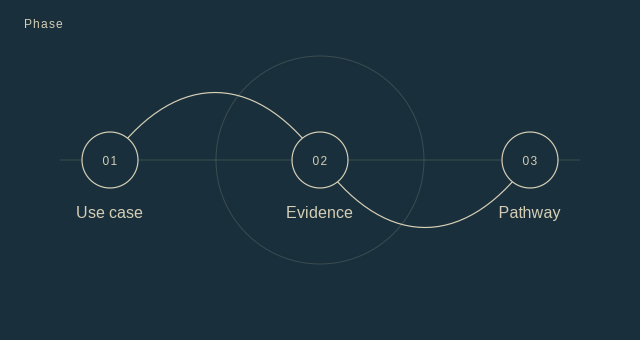
- Use caseDefine the user, task and conditions.
- EvidenceAgree what the next decision requires.
- PathwayAssign contributions, responsibilities and review points.
Define the contribution of each partner
Map the contributions needed along the pathway. A research team may bring scientific knowledge; another organisation may provide engineering capability, an evaluation environment or knowledge of the intended use. Set out what each contribution enables and where it enters the sequence. This makes partnership selection more deliberate. It also helps an institution identify dependencies, responsibilities and the questions that should be resolved before committing to a collaborative programme.
Use a decision point to organise the work
Consider an illustrative university research group exploring an application for a sensing method. Its next decision might concern whether to develop a prototype for evaluation with an external partner. A useful early work package would clarify the use case, the proposed evaluation conditions, the contribution expected from the partner and the evidence needed to justify that prototype. The resulting decision point links research effort with a defined institutional commitment.
Keep the pathway open to evidence
Review the pathway when findings change the intended use, when a partner’s contribution changes or when an enabling condition becomes clearer. A practical roadmap should record the next decision, the people responsible and the evidence required. It should also explain the basis for continuing, adjusting or concluding a line of work. This gives the institution a consistent way to concentrate effort on credible routes to contribution.
QUESTIONS FOR THE LEADERSHIP TEAM
- Who would use the research, and for which task?
- What contribution must each partner make?
- Which evidence would support the next institutional commitment?
THE STRATEGIC CONSIDERATION
Name the use case, define the partnership contribution and organise the pathway around evidence-producing decisions.